

Best Camping Mattress for Side Sleepers: 2026 Buyer's Guide
Table of Contents
- Why Side Sleepers Need a Different Camping Mattress
- Best Sleeping Pad for Side Sleepers: What to Look For
- Sleeping Pad Thickness for Side Sleepers: How Much Do You Need?
- Camping Mattress R-Value: Matching Warmth to Your Trip
- Car Camping Mattress for Side Sleepers: Comfort Without the Weight
- Firmness and Inflation Guide for Side Sleepers
- Durability, Repair, and Long-Term Value
- Frequently Asked Questions
Last Updated: October 19, 2026
Why Side Sleepers Need a Different Camping Mattress
Most camping mattresses are built for back sleepers, and it shows by 3 a.m. This guide from KoolBean Things covers how to pick a camping mattress for side sleepers without wasting money on a pad that bottoms out.

The core problem is pressure. Side sleeping concentrates your body weight on a narrow strip along your hip and shoulder.
That's the throughline for everything below: side sleepers need thickness, firmness and support tuned to pressure points, not just a soft top layer. Get those three right and camping becomes genuinely restful again.
Best Sleeping Pad for Side Sleepers: What to Look For
The best sleeping pad for side sleepers is one thick enough to keep your hip and shoulder off the ground when fully inflated, firm enough to resist bottoming out, and wide enough that you don't roll off the edge. Everything else, including brand, color and extras, is secondary to those three traits.
Here's what actually matters when you're comparing pads.
Pressure Relief and Support
Pressure relief comes from how a pad distributes your weight, not from how soft it feels.
Support is the flip side. You want the pad to hold your spine in a neutral line from hips to shoulders.
A common mistake is judging a pad by hand-press feel alone. Press your hip bone into it while lying on your side for a full minute, not three seconds.
Noise and Motion Transfer
Noise matters more than most buyers expect. Inflatable pads with a slick nylon surface can crinkle loudly every time you shift, which wakes light sleepers and tent partners. Foam-topped and fabric-faced pads run quieter.
Motion transfer is the other half. If you share a tent, a bouncy air pad transmits every movement. Foam layers and separate pads reduce that transfer.
Sleeping Pad Thickness for Side Sleepers: How Much Do You Need?
Sleeping pad thickness for side sleepers should be at least 6 to 8 cm (roughly 2.5 to 3 inches) when inflated. Thinner pads let your hip and shoulder bottom out. Thicker pads add comfort but also weight and packed size, so match thickness to how you'll camp.
Here's a simple way to think about it:
| Thickness | Best For | Trade-off |
|---|---|---|
| Under 5 cm | Back sleepers, ultralight trips | Bottoms out for side sleepers |
| 6-8 cm | Most side sleepers | Moderate weight and pack size |
| 9 cm and up | Car camping, heavier sleepers | Bulkier, heavier to carry |
If you're a lighter side sleeper, 6 cm can work. If you're heavier or a strict side sleeper who wakes with sore hips, lean toward 8 cm or more.
Why thickness is not the whole story
Thickness only helps if the pad resists compression at the hip and shoulder. A 10 cm pad inflated soft behaves like a 4 cm pad: your hip sinks until it meets the ground, your spine bends, and you wake up sore.
That is why the useful number is not just thickness but thickness at pressure. A pad with vertical air chambers or foam columns holds its shape better under a hip than a flat air bladder of the same height.
Match thickness to body type and sleep style
A single thickness recommendation does not fit every side sleeper. Use these ranges as a starting point, then adjust with inflation:
- Lighter side sleepers (under about 70 kg / 155 lb): 6 cm is often enough, especially on a firm inflatable. Going thicker mainly adds packed size.
- Average-weight side sleepers (70-90 kg / 155-200 lb): 7-8 cm is the sweet spot. This is where most side sleepers stop bottoming out without carrying a car-camping pad.
- Heavier side sleepers (over 90 kg / 200 lb): 8-10 cm, and favor pads with foam layers or sturdy baffles. Thin air pads collapse under concentrated hip pressure regardless of brand.
- Broad shoulders or wide hips: width matters as much as thickness. A 51 cm (20 in) pad can leave your shoulder hanging off the edge; 63 cm (25 in) or wider keeps your top shoulder supported.
The bottoming-out test
Before you trust a thickness rating, test it the way you actually sleep. Inflate the pad fully, lie on your side for a full two minutes, and slide a flat hand under your hip. If your hand slides in easily, the pad is holding you up. If it is pinched or you cannot get it under, the pad is bottoming out and no amount of top-layer softness will fix it.
Camping Mattress R-Value: Matching Warmth to Your Trip
Camping mattress R-value measures how well a pad resists heat loss to the ground. Higher R-value means warmer. Side sleepers should pay attention because a compressed pad loses insulation where your hip and shoulder press in, creating cold spots.
Match R-value to conditions:
- Summer and warm-weather car camping: a lower R-value pad is usually fine.
- Three-season camping: choose a mid-range R-value pad for cool nights.
- Cold-weather and shoulder-season trips: go higher, and pair the pad with a sleeping bag rated for the temperature.
The key insight for side sleepers: the more your hip compresses the pad, the more insulation you lose at that spot. A firm inflation level protects both comfort and warmth.
Car Camping Mattress for Side Sleepers: Comfort Without the Weight
Car camping changes the math entirely. When you're not carrying the pad on your back, you can prioritize thickness and comfort over packed size.
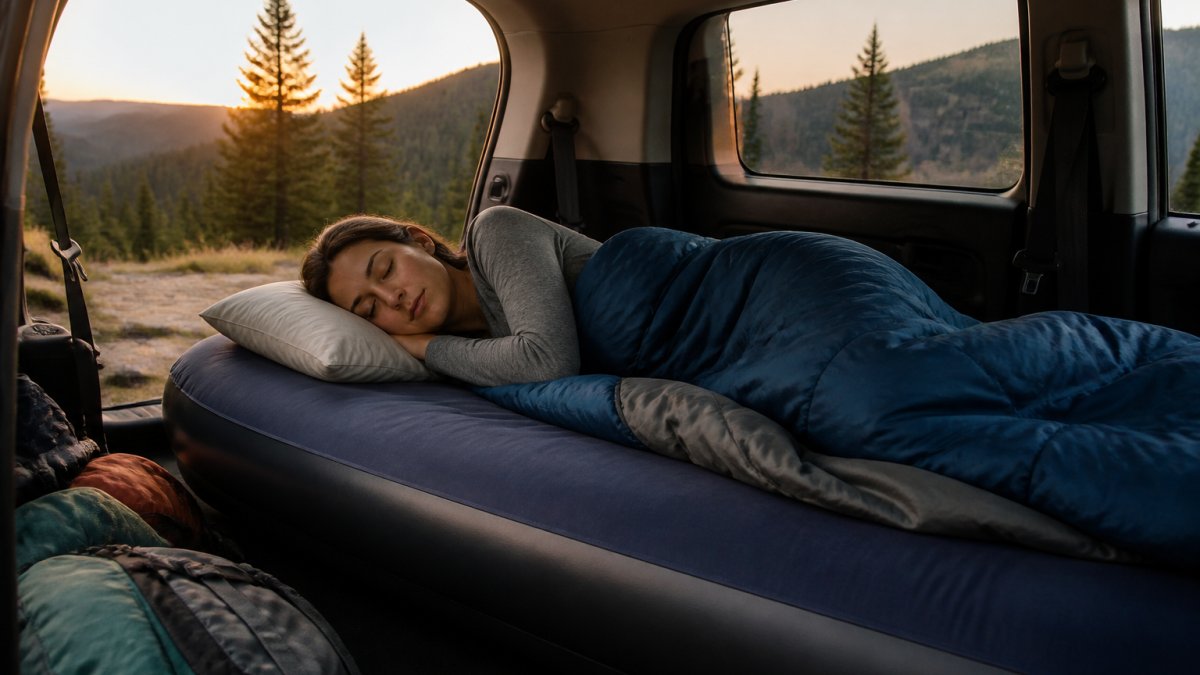
Compare the three car-camping designs
Side sleepers have three realistic options, and each trades off differently:
- Air mattresses (tall inflatables): the thickest option, often 15-25 cm, and the closest thing to a home mattress. They are comfortable for side sleepers but heavy, slow to inflate, and prone to motion transfer if two people share one. Look for internal baffles or coil structures that resist bottoming out at the hip.
- Self-inflating pads: foam core plus air, usually 5-10 cm thick. They are quieter and more stable than pure air, resist punctures better, and need less inflation effort. The trade-off is bulk and weight, and firmness is harder to fine-tune.
- Foam mats and foam-topped pads: the quietest and most durable, with no puncture risk. They are bulky to store and less cushioned unless thick, so side sleepers should choose a foam mat of at least 8 cm or a foam-topped air pad.
For a side sleeper who wants maximum comfort and does not carry gear far, a baffled air mattress or a thick self-inflating pad is usually the best fit. For couples, two individual pads side by side beat one shared air mattress: motion transfer drops, and each sleeper can set their own firmness.
What to check before you buy
- Inflated dimensions vs tent floor: measure your tent footprint. A pad that touches all four walls leaves no room for gear, and an oversized pad can bow against the tent fabric.
- Built-in pump or foot pump: car camping removes the weight penalty, so a built-in pump is a genuine convenience. Check the color or model name, some versions ship with a pump and some without.
- Built-in pillow section: useful for side sleepers because it keeps the head and neck aligned without a separate pillow that slides away overnight.
- Valve quality and repair kit: the valve is the most common failure point on air pads. A spare patch kit stored in the car costs little and saves a trip.
- Noise: slick nylon air mattresses crinkle. If you are a light sleeper or share a tent, a fabric-faced or foam-topped surface runs quieter.
Our Inflatable Camping Mattress fits the car-camping brief: it folds up small, includes a built-in pillow section, and comes in 12 color and pattern options. Some colors include a foot pump and some are sold without one, so check the color name before buying if you want the pump.
Firmness and Inflation Guide for Side Sleepers
Firmness is the most overlooked setting, and it's free to adjust. The right firmness for a side sleeper is firm enough that your hip doesn't touch the ground but soft enough that your shoulder isn't compressed into a pressure point.
Use this quick inflation guide:
- Inflate the pad fully, then lie on your side for two minutes.
- Slide a flat hand under your hip. If you can't, the pad is too soft or too thin.
- Check your shoulder. If it aches or goes numb, add a little more air.
- Check your spine line. Hips and shoulders should sit roughly level.
- Re-check after an hour. Temperature changes affect firmness.
A self-inflating pad gives you less control over firmness than a pump or valve-inflated air pad. Air pads let you fine-tune, which matters more for side sleepers than for back sleepers.
Durability, Repair, and Long-Term Value
Durability is where cheap pads quietly fail.
What to check before you buy:
- Puncture resistance: a tougher face fabric resists ground debris and tent-floor abrasion.
- Valve quality: a solid inflation valve is the most common failure point on air pads.
- A repair kit: many pads ship with a patch kit. Keep it in your pack, always.
Long-term value comes from a pad that holds air trip after trip, not the cheapest one on the shelf.
At KoolBean Things, every order ships tracked, and unused items in original packaging can be returned within 30 days of delivery, so you can check fit and firmness before committing to a full season.
Picking the right pad for side sleeping comes down to thickness, firmness and support, not brand hype. Browse the Inflatable Camping Mattress at KoolBean Things, check the color options for the built-in pump, and get set up for a full night's sleep outdoors. Continue shopping with tracked shipping and a 30-day return policy on unused items.
Frequently Asked Questions
What is the best camping mattress for side sleepers?
The best camping mattress for side sleepers is one that combines enough thickness to keep your hip and shoulder off the ground with a supportive foam or air chamber design. Look for at least 7-10 cm (3-4 inches) of thickness, an R-value of 4 or higher for three-season use, and a surface that limits motion transfer. Inflatable mattresses with a built-in pillow section, like the KoolBean Things Inflatable Camping Mattress, can simplify your setup and reduce the need for extra pillows.
How thick should a sleeping pad be for side sleepers?
Sleeping pad thickness for side sleepers should be at least 7 cm (about 3 inches) to prevent bottoming out. If you weigh more than 80 kg (176 lbs) or sleep on hard ground, aim for 10 cm (4 inches) or more. Thicker pads distribute pressure better around the hip and shoulder, but they also pack larger and take longer to inflate. Self-inflating foam pads in the 5-8 cm range can work for lighter sleepers who want a simpler setup.
What R-value do I need for a camping mattress?
Camping mattress R-value measures insulation. For summer camping, an R-value of 1.5 to 3 is usually enough. For three-season trips (spring through fall), choose R-4 to R-5. For winter or cold ground, go with R-6 or higher. Side sleepers lose heat where hips and shoulders compress the pad, so a higher R-value helps maintain warmth. Pair your mattress with a sleeping bag rated for the temperature and consider a foam mat underneath for extra insulation.
Are self-inflating sleeping pads comfortable for side sleepers?
Self-inflating sleeping pads can be comfortable for side sleepers if they are thick enough, typically 5-8 cm (2-3 inches). They offer foam support and tend to be quieter than pure air mattresses. However, lighter side sleepers may bottom out on thinner models. Test your pad at home before your trip, and if you feel pressure points, add a closed-cell foam pad underneath or switch to a thicker air mattress with a higher R-value.