

How to Verify Online Store Reliability: A 2026 Guide
Table of Contents
- Step 1: Check the Store's Business Identity and Contact Details
- Step 2: Assess Website Quality and Look for Online Shopping Scam Warning Signs
- Step 3: How to Spot Fake Online Reviews and Verify Customer Feedback
- Step 4: Verify Security and Safe Payment Methods for Online Shopping
- Step 5: Review the Online Store Return Policy Checklist Before You Buy
- Step 6: Verify Seller Reputation and Marketplace Presence
- Step 7: Make Your Final Decision and Complete Your Purchase Safely
- Frequently Asked Questions
Last Updated: October 11, 2026
Step 1: Check the Store's Business Identity and Contact Details
To verify online store reliability, check for clear contact information: a physical address, phone number, and email. Search the address online and call the number to confirm it's real and someone answers.
Check the domain name carefully. Scammers use URLs that mimic well-known retailers with slight variations (e.g., "amaz0n.com" instead of "amazon.com"). Legitimate businesses register domains that match their brand name clearly.
Search for the company name plus "reviews" or "complaints" online. If the store claims years of operation but has almost no online presence, that's a red flag. Verify their social media accounts match their website branding and show genuine activity.
Step 2: Assess Website Quality and Look for Online Shopping Scam Warning Signs
Scan the website for spelling mistakes, poor grammar, and unprofessional design. Broken images, outdated information, or sloppy layouts suggest the business isn't serious about customer experience.
Check for "https://" at the start of the URL and a padlock icon in your browser's address bar. Never enter payment information without these security indicators.
Compare prices across multiple legitimate retailers. If prices seem too good to be true, they probably are, scammers lure shoppers with unrealistic discounts.
Avoid pressure tactics: countdown timers, urgent language like "Buy now or miss out," and fake scarcity warnings. Real retailers don't manipulate you into buying immediately.
Step 3: How to Spot Fake Online Reviews and Verify Customer Feedback
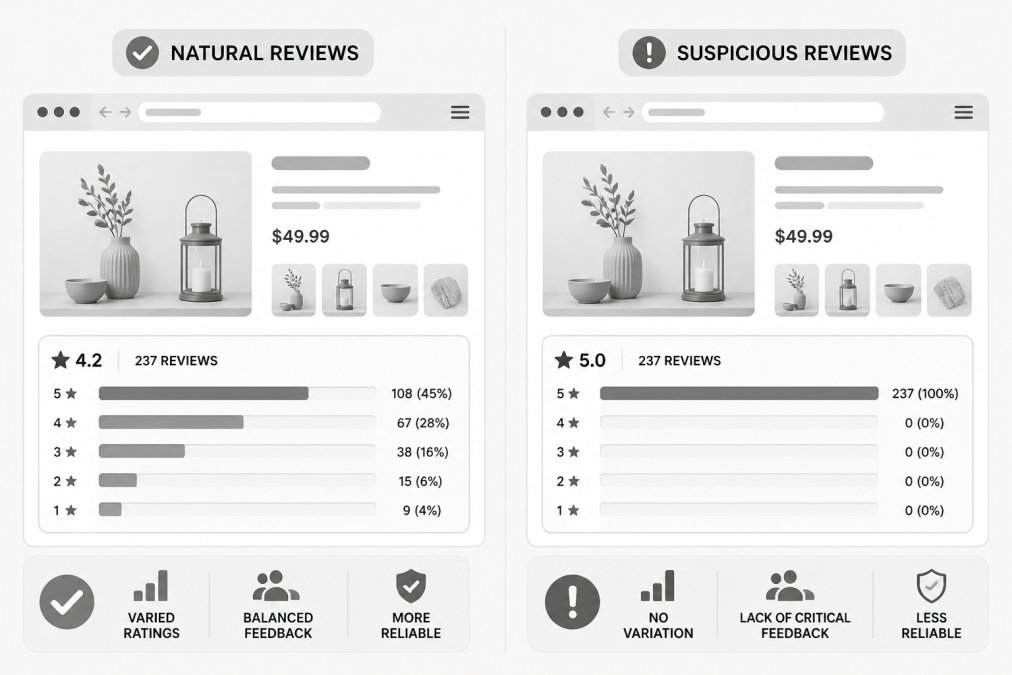
Check review distribution and recency. If 50+ five-star reviews appeared within two weeks, that's a manipulation signal. Look for a natural mix of one- through five-star ratings. Products with only five-star and one-star reviews (no middle ground) suggest planted reviews. Genuine products cluster around three to four stars.
Assess review specificity. Fake reviews use generic language: "Great product!" "Highly recommend!" Authentic reviews mention specific details, dimensions, weight, durability, or comparisons to competitors. If most reviews lack concrete detail, the review base is suspect.
Verify reviewer credibility. Do reviewers have a history across different product categories and sellers, or only this store? Accounts reviewing exclusively one retailer are often fake. Legitimate reviewers vary their writing style across purchases.
Cross-reference reviews on independent platforms. Search for the store on Trustpilot, Sitejabber, or the Better Business Bureau. If a store has 4.8 stars on its own site but 2.1 stars on Trustpilot, the independent platform reveals the truth. Look for consistent complaint patterns across platforms, items not shipped, wrong products, poor communication.
Watch for review timing spikes. If a product suddenly received 30 reviews in three days after months of two per week, that spike suggests purchased reviews.
Look for reviews mentioning both strengths and weaknesses. A review saying "The product works well but shipping took three weeks" is more credible than "Perfect in every way." If reviews praise everything without reservation, skepticism is warranted.
Check if the store responds to negative reviews. Legitimate retailers respond professionally to complaints. Stores that delete negative reviews or never respond are less transparent.
Step 4: Verify Security and Safe Payment Methods for Online Shopping
Safe payment methods protect you both during checkout and after a purchase goes wrong. Understanding your options and recovery paths is essential.
Choose payment methods with buyer protection. Credit cards offer the strongest protection.
PayPal, Apple Pay, and Google Pay offer dispute resolution separate from your bank. PayPal Buyer Protection covers unauthorized transactions and items not received or not as described.
Avoid payment methods with no recourse. Never use wire transfers, ACH transfers, or cryptocurrency. These are nearly impossible to reverse. Scammers request these because you have no protection.
Verify checkout security. Look for "https://" at the start of the URL and a padlock icon in the address bar. If you don't see these signals, stop. Do not enter your payment information.
Protect your information. Legitimate retailers need only your name, address, email, and payment card details. If a checkout form asks for your Social Security number, driver's license, or bank account number, that's suspicious.
Know your dispute process. Contact the retailer first and give them 5 to 7 days to respond. If unresolved, file a dispute with your payment provider.
Document your purchase immediately. Save the order confirmation email, order number, and tracking information. Take screenshots of the product listing, price, and any seller communications. Store these in a folder or cloud service.
Monitor your accounts after purchase. For 30 to 60 days after buying from a new retailer, check your credit card and bank statements regularly. Look for unauthorized charges or duplicate transactions.
Understand the timeline for refunds. If your dispute is approved, the refund doesn't happen instantly. Credit card chargebacks typically take 5 to 10 business days to process once the card issuer rules in your favor.
Step 5: Review the Online Store Return Policy Checklist Before You Buy
A strong return policy protects you if the product isn't what you expected. Before you buy, read the return policy completely. Legitimate retailers make this easy to find, usually in a footer link or clearly labeled on the website.
Check the return window. How many days do you have to return an item? Thirty days is standard (the FTC). Some retailers offer longer periods. If a store has no returns or only accepts returns within 7 days, be cautious.
Look for return shipping costs. Does the retailer pay for return shipping, or do you? Free returns are becoming standard because they reduce customer friction. Stores that make you pay shipping are less customer-friendly.
Read the condition requirements. Can you return items if you've opened the box? Do items need to be unused? Reasonable policies allow returns on unused items. Policies that require items in "like-new condition" with all original packaging are strict but not unreasonable.
Check what happens when you return an item. How long does the refund take? Do you get your full purchase price back, or are there restocking fees? Transparent retailers clearly state this information. If the policy is vague or hard to find, contact customer service and ask specific questions.
Step 6: Verify Seller Reputation and Marketplace Presence
If you're buying from a marketplace like Amazon or eBay, check the seller's reputation directly. These platforms show seller ratings and customer feedback. Look for sellers with high ratings (4.5+ stars) and many reviews. New sellers with few reviews are riskier than established sellers with hundreds of transactions.
Read the seller's feedback comments. Look for patterns in what customers say. Positive feedback about shipping speed, product quality, and communication indicates a reliable seller. Negative feedback mentioning items not matching descriptions or poor communication is a warning sign.
Check how long the seller has been active. Sellers who have operated for years are less likely to be scams than brand-new accounts. Established sellers have reputations to protect.
Search for the retailer's social media presence. Legitimate businesses maintain active social accounts. Look for regular posts, customer interactions, and consistent branding across platforms. A business with no social media presence at all is less transparent than one that engages with customers online.
Verify the seller's business registration if possible. Many legitimate retailers display business licenses or registrations on their websites. You can often verify these through your state or country's business registration database.
Step 7: Make Your Final Decision and Complete Your Purchase Safely
After completing all verification steps to verify online store reliability, you're ready to decide. Create a checklist of what you've confirmed: business identity verified, website secure, reviews appear authentic, payment method is safe, return policy is clear, and seller reputation is solid. If you've checked all these boxes, the store is likely legitimate.
Before finalizing your purchase, review your order one more time. Confirm the product description, price, and shipping address are correct. Double-check that you're buying from the correct seller if the marketplace has multiple options.
When you complete your purchase, save all confirmation emails and order numbers. Store this information in a safe place. You'll need it if you need to contact customer service or file a dispute.
Keep records of your purchase for at least 30 days. Save screenshots of product descriptions, prices, and any communications with the seller. This documentation helps if you need to file a chargeback with your credit card company or dispute with your payment provider.
Track your shipment using the tracking number provided. Legitimate retailers send tracking information quickly. If you don't receive tracking details within a few days, contact the seller to ask for an update. When your package arrives, inspect it immediately to confirm it matches the description and is undamaged.
Verifying online store reliability protects your money and your personal information. The steps above take time, but they eliminate most scams and reduce the risk of buying from fraudulent retailers. At KoolBean Things, we make verification simple by providing tracked shipping on all orders, maintaining transparent business information, and offering a flexible 30-day return policy on unused items.
Frequently Asked Questions
How do I know if an online store is legit?
Check for a physical business address, working contact details, and clear company information on the website. Look for HTTPS security, genuine customer reviews on independent sites, and a transparent return policy. Verify the domain age and check if the store appears on marketplace platforms. Legitimate stores display trust marks, respond to customer inquiries, and have consistent branding. If something feels rushed or unclear, trust that instinct.
What are the main online shopping scam warning signs I should watch for?
Red flags include unusually low prices with artificial urgency ('Buy now, limited stock'), poor spelling and grammar throughout the site, no physical address or phone number, vague product descriptions, requests for wire transfers or gift cards, and missing or unclear return policies. Avoid stores with no customer reviews or only five-star reviews. Check if the website looks professionally designed and matches the brand's social media presence. Scammers often rush you into quick decisions.
How can I tell if online product reviews are real?
Real reviews include specific details about product performance, delivery, and customer service. Fake reviews often use generic praise, identical phrasing across multiple entries, or suspiciously perfect five-star ratings. Check review dates, genuine feedback spreads over time. Look for reviews on independent review sites, not just the store's own website. Read one-star and three-star reviews carefully; they reveal honest weaknesses. Verify reviewer profiles have purchase history and other reviews. Be cautious of reviews that seem written by the business itself.
What should I check in an online store's return policy before buying?
Ensure the policy clearly states the return window (KoolBean Things offers 30 days on unused items), whether return shipping is free or paid, and how refunds are processed. Verify the store accepts returns for legitimate reasons, not just defective items. Check if restocking fees apply. Look for a hassle-free process, legitimate stores make returns simple. Read customer feedback about actual return experiences; some stores claim easy returns but make them difficult. A transparent, customer-friendly return policy is a strong trust signal.