

Top Rated Outdoor Gadgets 2026: What to Buy
Table of Contents
- How to Judge Top Rated Outdoor Gadgets in 2026
- Best Camping Gear 2026: Tents, Mattresses, and Coolers
- Best Outdoor Tech Gadgets: Power, Light, and Navigation
- Camping Gadgets for Beginners: Start With These
- Lightweight Hiking Gadgets for Weekend Trips
- Side-by-Side Specs: What Separates Good Gear From Gimmicks
- Gadgets Worth Skipping (and What to Buy Instead)
- Conclusion: Buying Outdoor Gadgets That Last
- Frequently Asked Questions
Last Updated: October 6, 2026
How to Judge Top Rated Outdoor Gadgets in 2026
Most "top rated outdoor gadgets 2026" lists rank products by star count and call it a day. That fails because ratings measure first impressions, not fifth-season survival.
Outdoor gadgets are portable tools built for camping, hiking, backpacking, and weekend trips, from tents and lanterns to solar chargers and fish finders. The best ones share one trait: durability you can measure before you buy.
Our framework for judging any piece of camping gear:
- Check the material rating, not the marketing. Look for denier counts on fabrics, IP ratings on electronics, and temperature ratings on sleeping gear.
- Read the warranty terms in full. A two-year warranty signals confidence; a 30-day window signals the opposite.
- Search for repair parts. If the brand sells replacement valves, cables, or batteries, the product is designed to last.
Specs That Actually Predict Durability
Three numbers predict whether outdoor gear survives real use: waterproof rating, battery cycle life, and load capacity. A tent listed as "waterproof" without a hydrostatic head figure tells you nothing. A power bank without a stated charge cycle count is a gamble. When a listing omits these specs, treat that silence as the answer.
Warranties, Repairs, and Product Lifespan
A warranty is the manufacturer's own bet on the product. Longer coverage usually tracks with better components. Repairability matters just as much, since a replaceable part keeps a good gadget out of a landfill. The FTC guidance on warranty language explains what "limited warranty" legally means, which helps you compare claims fairly.
Best Camping Gear 2026: Tents, Mattresses, and Coolers
The best camping gear 2026 has to solve three problems: fast shelter, comfortable sleep, and food that stays cold. Get the shelter right first, because a wet night ruins every trip that follows.
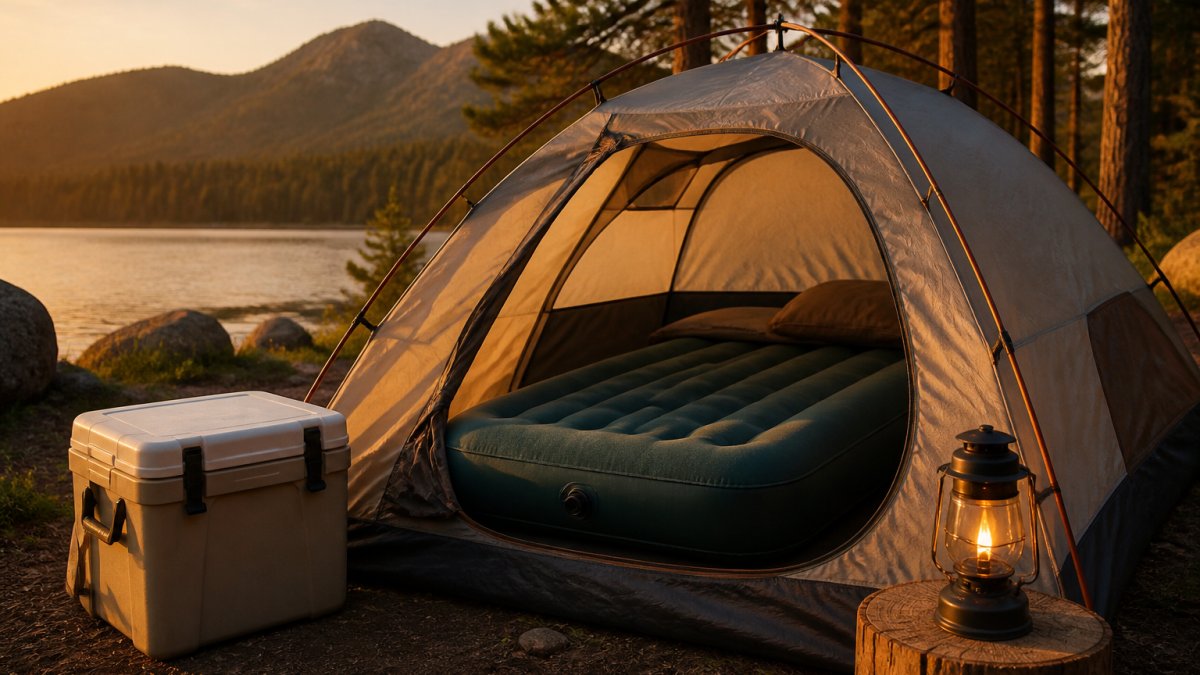
Rapid Setup Shelters and Inflatable Tents
Setup time is the most underrated spec in camping. A shelter that takes 20 minutes in daylight takes far longer in rain and wind.
Check three things before buying: packed weight, packed size, and the pump situation. Some inflatable designs include a built-in foot pump and others require a separate one, the difference between a two-minute and a ten-minute setup.
Sleeping and Food Storage That Holds Up
Sleep quality decides whether anyone wants to camp again.
One practical note: some color options include a foot pump and some ship without one, so check the color name before ordering. Square, grid, and wide styles cost more than standard shapes.
For food storage, a cooler only performs as well as its seal. Look for a gasket that compresses evenly and a drain plug you can actually reach.
Best Outdoor Tech Gadgets: Power, Light, and Navigation
The best outdoor tech gadgets share one job: they must work when your phone does not.
Power starts with a power bank rated in charge cycles, not just capacity.
Light means a headlamp for hands-free work and a lantern for camp.
Navigation covers GPS watches and handheld units. Offline maps matter more than screen size, because signal disappears exactly where you need it.
Sonar tools deserve a mention for anglers. A handheld fish finder with a 45° beam angle and a depth range from 3 ft to 328 ft reads bottom contours, weeds, and fish location from a boat, kayak, dock, or ice hole.

Camping Gadgets for Beginners: Start With These
Camping gadgets for beginners should be few, cheap, and hard to break. New campers overspend on gear they never use and skip the basics they need. Start with light, sleep, and water, then add comfort items after your first few trips.
A sensible first kit, with the specs that matter:
- A headlamp with a red-light mode for night vision. Look for at least 200 lumens on high and a stated runtime at that brightness, not just an eco-mode figure.
- A lantern with a stated runtime figure. A 400-lumen lantern that runs 6 hours on high beats a 1000-lumen model that dies in 90 minutes. Check whether it uses standard batteries or a proprietary cell.
- An inflatable mattress instead of a thin foam pad. Check the packed size and whether a pump is included. One that packs to water-bottle size and inflates in two minutes beats a bulky pad you dread setting up.
Buy mid-range versions of each. Upgrading a $30 headlamp you understand beats replacing a $120 impulse buy. Beginner-friendly gear is gear you can operate in the dark, half-asleep, without instructions.

Safety and Offline Reliability for First-Timers
Two failure modes ruin beginner trips: dead batteries and no signal. Before you leave, test every electronic gadget at home. Run the headlamp for an hour, charge the power bank fully, and confirm the lantern works.
Offline operation matters more than app features.
Battery and fire safety are non-negotiable. Never charge a power bank inside a sealed tent where heat can build up, keep all electronics away from open flames and camp stoves, and stop using a battery immediately if it swells.
A Note on Testing and Durability
Most beginner gear lists recommend products based on star ratings, which tells you how a product performed on day one, not how it survives a season. Look instead for gear that publishes measurable specs and has a repair path: a headlamp with a replaceable battery and a stated IPX rating beats a sealed unit with no rating.
Lightweight Hiking Gadgets for Weekend Trips
Lightweight hiking gadgets earn their place by cutting grams without cutting function. Weekend trips are the ideal testing ground, because two days of carrying a pack exposes every unnecessary item fast.
The rule to consider: every gadget must justify its weight against a lighter alternative. A headlamp beats a lantern on the trail.
But weight is only one axis. The best lightweight gadgets also score on repairability, battery cycle life, and weather resistance.
What to Look For (and What to Skip)
- Headlamp: Aim for under 3 oz with a red-light mode and a stated runtime at 100+ lumens. Look for a replaceable battery or a standard USB-C charging port. Avoid proprietary charging cables that you can't replace on the trail.
- Power bank: For a two-night trip, 10,000 mAh is usually enough for a phone and a headlamp. Check the charge cycle rating: 500+ cycles outlasts 300. A 10,000 mAh bank typically weighs 6-8 oz.
- Navigation: A GPS watch or handheld unit adds weight, but offline maps can replace a paper map and compass for some hikers. If you carry a phone, download offline maps and bring a small backup battery. A dedicated handheld GPS often weighs 5-8 oz and runs on easy-to-replace AA batteries.
Repairability and Longevity on the Trail
Lightweight gear often sacrifices durability for grams, but not always. Check for user-replaceable parts: a headlamp with a replaceable battery and standard O-ring seal can be repaired in the field, while a power bank with a sealed case cannot.
Warranties matter here too. A two-year warranty signals the manufacturer expects the gadget to survive more than a few trips; a 30-day warranty suggests the opposite.
How We Test Lightweight Gear
Most lightweight gear lists are based on spec sheets and first impressions. Long-term testing is rare in roundups, but it's the only way to know whether a gadget will still work on your fifth trip, not just your first.
| Gadget Type | What to Check | Common Mistake | Better Choice |
|---|---|---|---|
| Power bank | Charge cycle rating | Buying by mAh alone | Mid-capacity with good cells |
| Headlamp | Runtime at full brightness | Trusting "eco mode" hours | Model with red-light mode |
| Mattress | Packed size and pump | Missing pump in box | Check color name for pump |
| Cooler | Gasket seal and drain plug | Judging by exterior size | Test the lid seal in store |
| Fish finder | Beam angle and depth range | Testing in a bucket | Test in open water |
Weather resistance matters here too. Look for IP ratings on anything electronic, and check that zippers and seams on packs and pouches are taped or sealed.
Side-by-Side Specs: What Separates Good Gear From Gimmicks
Gimmicks hide behind adjectives; good gear publishes numbers. If a listing cannot tell you the battery life, the waterproof rating, or the packed weight, that absence is your answer. The REI outdoor gear care and repair guides are a useful reference for understanding which components typically fail first.
Three questions separate the two categories:
- Does the spec sheet list measurable figures? Depth range, beam angle, denier, IP rating.
- Can the product be repaired or does it need replacing? Replaceable batteries and cables signal longevity.
- Does the brand still support it in three years? Firmware support and spare parts answer this.
Genuinely useful gadgets tend to be boring: they do one job, list their specs, and last. Gimmicks are exciting, vague, and disposable.
Gadgets Worth Skipping (and What to Buy Instead)
Skip anything that adds an app where a button would do. Bluetooth-connected camp gear sounds clever until the battery dies and the device becomes a paperweight.
Also skip:
- Solar panels sold as primary chargers. They work as backups, not main power.
- Multi-tools with 30 functions. Most go unused; a good knife and a small screwdriver set cover more ground.
- "Smart" coolers with built-in speakers. The speaker drains the battery that should be keeping food cold.
Buy instead: a reliable headlamp, a mattress you have actually inflated once, a power bank with a stated cycle life, and a cooler with a tested seal. Sustainability and lifespan go together here, because a gadget you keep for five years beats three cheap replacements.
Conclusion: Buying Outdoor Gadgets That Last
Everything looks capable in a product photo. Specs, warranties, and repairability separate equipment that survives a season from equipment that survives a decade. KoolBean Things stocks outdoor finds built around that idea, with tracked shipping on every order and a flexible 30-day return policy on unused items, so you can check the fit before you commit. Browse our outdoor range and pick gear that earns its place in your pack.
Frequently Asked Questions
What are the best outdoor gadgets for 2026?
The strongest picks solve a real problem on a specific trip: an inflatable camping mattress for sleep, a handheld fish finder for locating fish and reading depth, a solar charger or power bank for off-grid power, and an LED lantern or headlamp for hands-free light. Judge each one on battery life, weather resistance, and whether replacement parts are available, not on how it looks in a product photo.
What camping gadgets are best for beginners?
Start with the basics that cover sleep, light, and food. An inflatable camping mattress with a built-in pillow, a rechargeable lantern, a simple camp stove, and a cooler with a solid lid gasket will handle most weekend trips. Add a power bank for phones and a basic first-aid kit. Skip app-connected gadgets on your first few trips until you know what you actually miss.
How do I choose durable outdoor gadgets?
Check three things before buying: the materials and construction (sealed seams, metal buckles, thick fabrics), the warranty terms and whether spares are sold, and the firmware or battery support window for anything electronic. Gear that can be repaired or has replaceable batteries will outlast sealed units. A 30-day return policy also lets you test fit and function before committing.
What lightweight hiking gadgets should I pack for a weekend outdoors?
Keep the load under a couple of kilograms for gadgets alone. A headlamp beats a handheld torch for hands-free use, a compact power bank replaces several chargers, and a pocket-size fish finder or GPS watch covers navigation and fishing without bulk. Look for gear that folds, nests, or clips to your pack, and check the weight in grams before you buy.